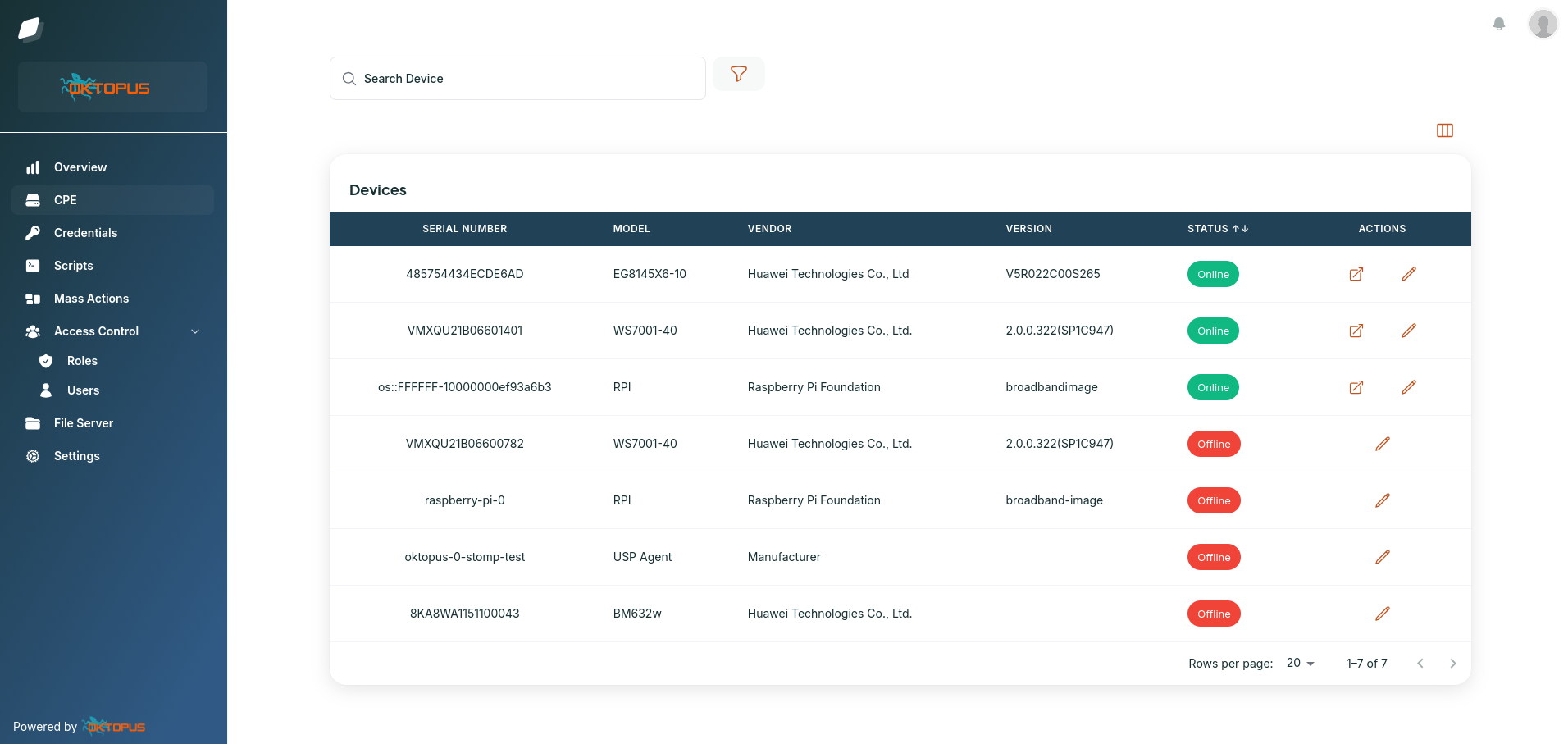
Coleta de Dados em Massa em Tempo Real TR-369 (USP)


The TR-369 (USP) introduces a fundamentally different approach to data collection compared to legacy device management protocols. Instead of relying on periodic polling, USP enables continuous, event-driven data streaming through its Bulk Data Collection mechanism.
Data Flow
Oktopus architecture streams real time telemetry data from the CPE to the microservices responsible to handle diagnostics, alerts, QoE/QoS analysis, and management UI.
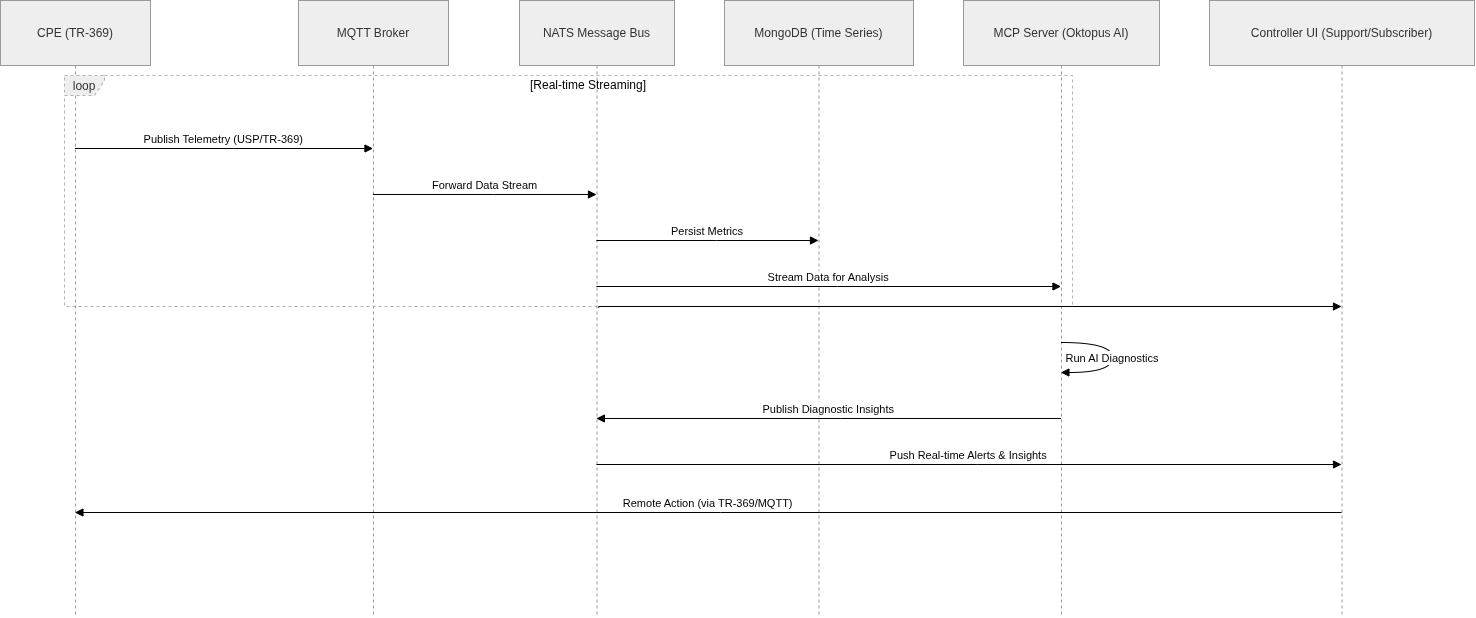
After the CPE is connected to the USP Controller, you can define Bulk Data profiles and receive JSON or CSV reports in the configured interval.
Add USP Bulk Data Profile Example
{
    "header": {
        "msg_id": "b7dc38ea-aefb-4761-aa55-edaa97adb2f0",
        "msg_type": 8
    },
    "body": {
        "request": {
            "add": {
                "allow_partial": true,
                "create_objs": [
                    {
                        "obj_path": "Device.BulkData.Profile.",
                        "param_settings": [
                            {
                                "param": "EncodingType",
                                "value": "JSON",
                                "required": true
                            },
                            {
                                "param": "Name",
                                "value": "USP MQTT Profile 1",
                                "required": true
                            },
                            {
                                "param": "ReportingInterval",
                                "value": "1",
                                "required": true
                            },
                            {
                                "param": "Protocol",
                                "value": "MQTT",
                                "required": true
                            },
                            {
                                "param": "MQTT.PublishTopic",
                                "value": "oktopus/usp/v1/bulkdata/cpe-test-1",
                                "required": true
                            },
                            {
                                "param": "MQTT.Reference",
                                "value": "Device.MQTT.Client.1",
                                "required": true
                            },
                            {
                                "param": "MQTT.PublishQoS",
                                "value": "0",
                                "required": true
                            }
                        ]
                    },
                    {
                        "obj_path": "Device.BulkData.Profile.[Name==USP MQTT Profile 1].Parameter.",
                        "param_settings": [
                            {
                                "param": "Name",
                                "value": "Hosts",
                                "required": true
                            },
                            {
                                "param": "Reference",
                                "value": "Device.Hosts.Host.*.",
                                "required": true
                            }
                        ]
                    },
                    {
                        "obj_path": "Device.BulkData.Profile.[Name==USP MQTT Profile 1].Parameter.",
                        "param_settings": [
                            {
                                "param": "Name",
                                "value": "ApAssociatedDevice",
                                "required": true
                            },
                            {
                                "param": "Reference",
                                "value": "Device.WiFi.AccessPoint.*.AssociatedDevice.*.",
                                "required": true
                            }
                        ]
                    }
                ]
            }
        }
    }
}
The above configuration is executed in the background, while the operator will be able to receive near real-time information coming from the profile.
Legacy Approach With TR-069
TR-069 operates on a request-response model. The CPE periodically calls the ACS (Auto Configuration Server), opening a session where the server can request parameters, push configurations, or trigger actions. Once the session ends, the connection is closed, and no further communication occurs until the next scheduled Periodic Inform or Connection Request.

This design introduces inherent limitations when it comes to data collection. Since the server must explicitly request data, obtaining high-frequency telemetry becomes inefficient and resource-intensive. Increasing the polling frequency leads to a proportional increase in session overhead, network traffic, and processing load on both the ACS and the devices. In large-scale deployments, this quickly becomes a bottleneck.
Moreover, TR-069 lacks native mechanisms for continuous or event-driven data streaming. While workarounds exist, such as scheduled parameter collection or vendor-specific extensions, they are often complex, inconsistent across devices, and not designed for real-time use cases. The result is a system that provides snapshots of the network state rather than a live view.
Real World Use Cases
In platforms like Oktopus, USP bulk data collection unlocks new operational capabilities.
Um exemplo claro é a visibilidade em tempo real dos dispositivos conectados a um CPE. Em vez de consultar periodicamente o roteador sobre seus clientes conectados, o Oktopus pode receber atualizações contínuas sobre os dispositivos à medida que eles se conectam, desconectam ou se movem pela rede. Isso inclui métricas como RSSI, permitindo que os operadores observem flutuações na intensidade do sinal conforme um usuário se aproxima ou se afasta fisicamente do roteador.
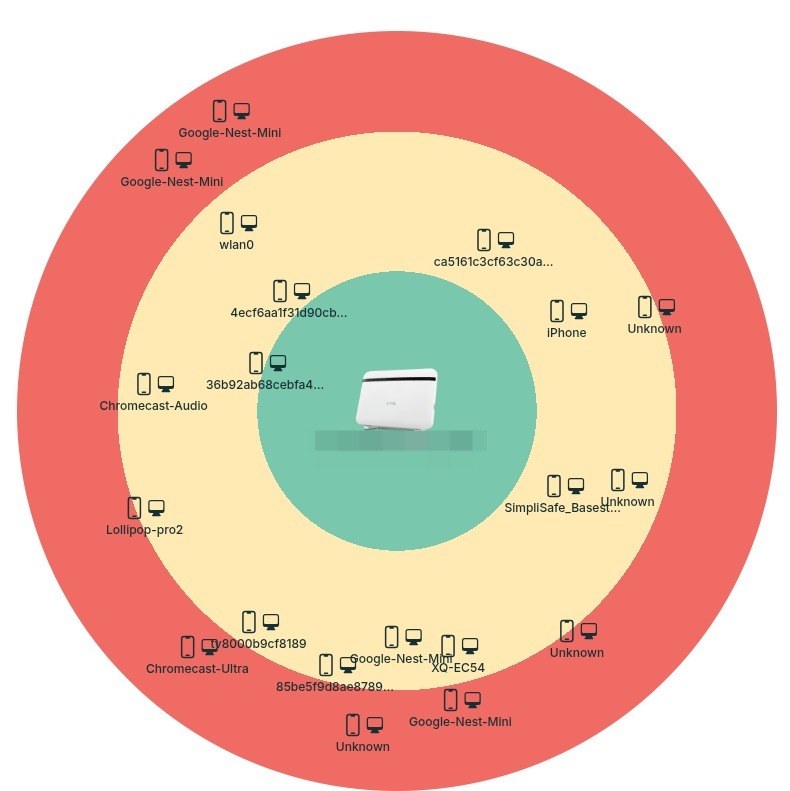
Esse nível de granularidade possibilita uma nova classe de análise de serviço e diagnóstico. As equipes de suporte não ficam mais limitadas a capturas estáticas da rede; elas podem observar o comportamento conforme ele acontece.
Além disso, fluxos de telemetria contínuos podem alimentar diagnósticos automatizados e alertas inteligentes. Em vez de esperar por uma reclamação do cliente, o sistema pode detectar anomalias proativamente, abrindo caminho para um suporte preditivo e uma melhor experiência do cliente.
Conclusão
A coleta de dados em massa em tempo real representa uma mudança da gestão de rede reativa para a proativa. Ao transformar dispositivos em produtores contínuos de dados, o USP permite que as plataformas construam um panorama dinâmico e em evolução da rede, em vez de depender de informações atrasadas ou incompletas.
Assuma o controle da sua
rede hoje mesmo
O USP Controller e ACS TR-069 mais utilizado no mundo, com
recursos de nível empresarial e sem dependência de fornecedor.