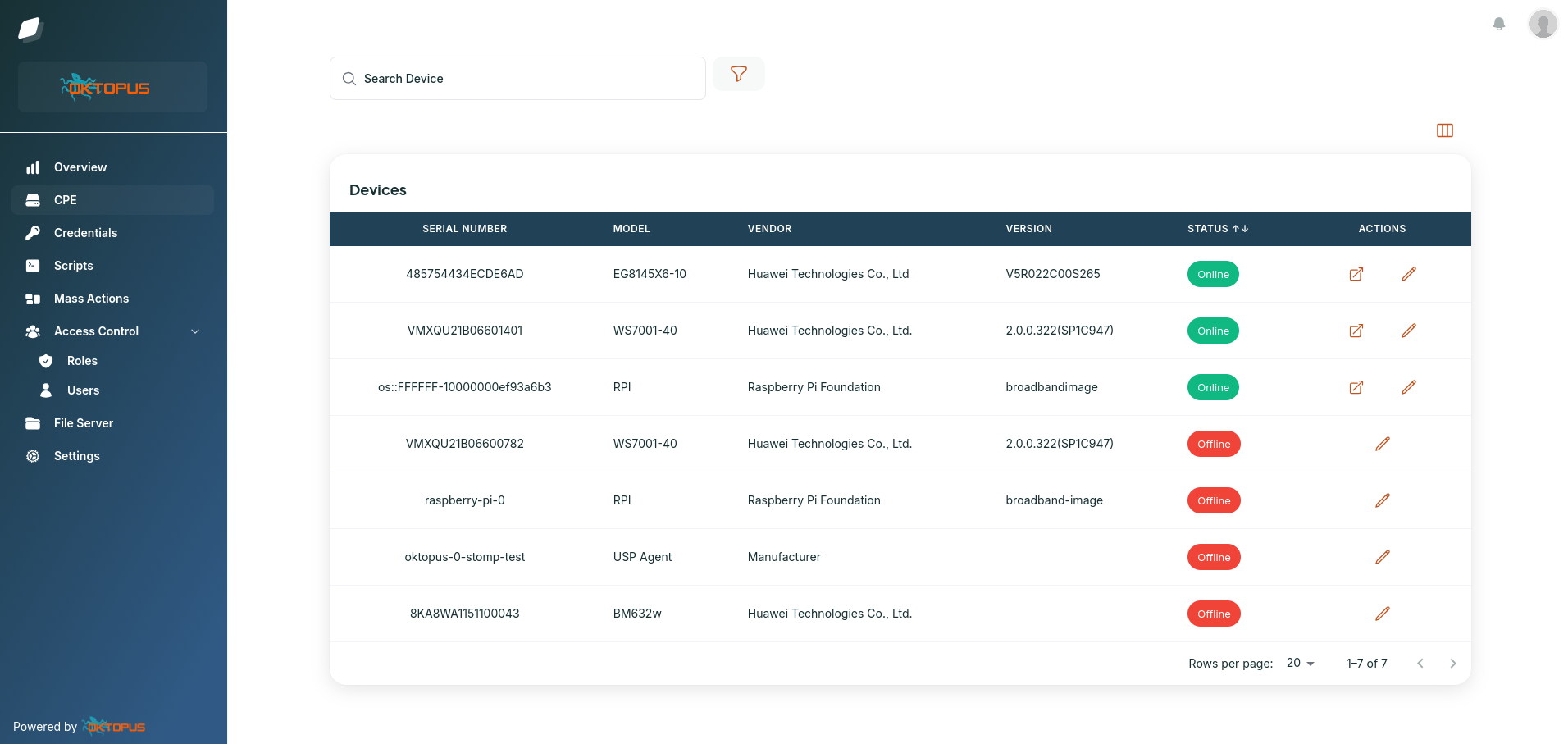
TR-369 (USP) Real-Time Bulk Data Collection


The TR-369 (USP) introduces a fundamentally different approach to data collection compared to legacy device management protocols. Instead of relying on periodic polling, USP enables continuous, event-driven data streaming through its Bulk Data Collection mechanism.
Data Flow
Oktopus architecture streams real time telemetry data from the CPE to the microservices responsible to handle diagnostics, alerts, QoE/QoS analysis, and management UI.
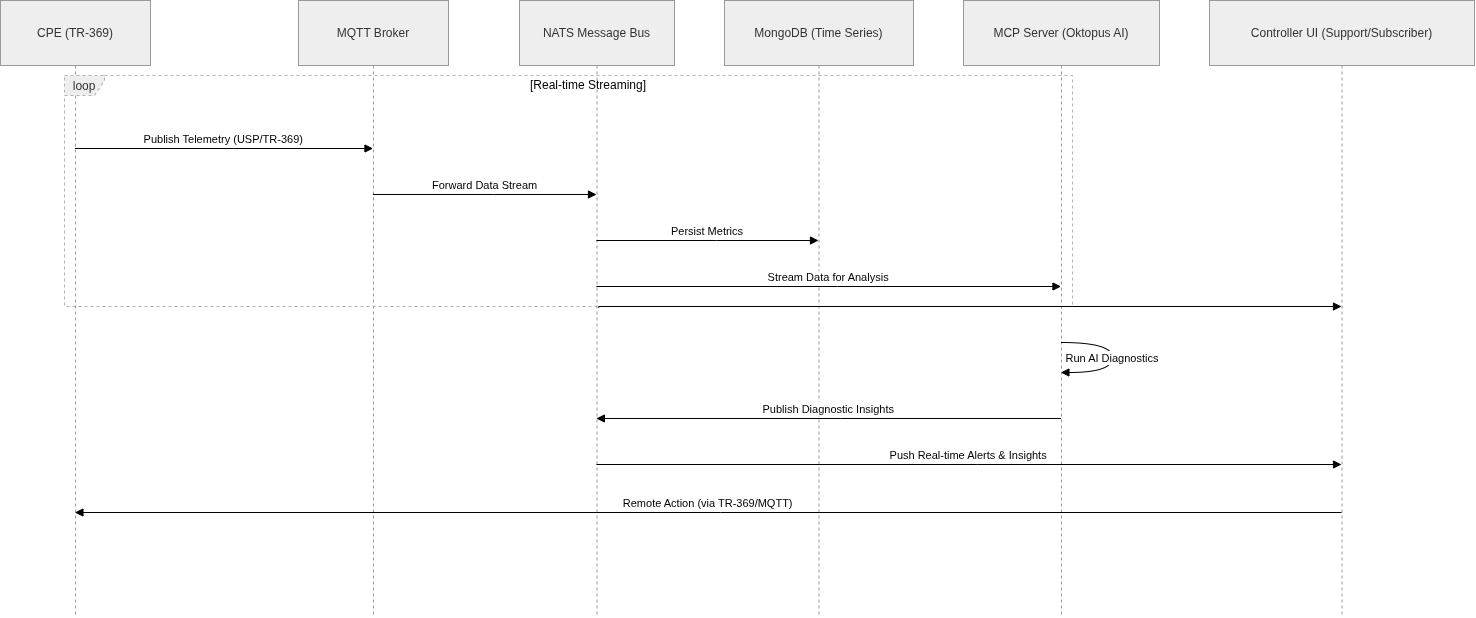
After the CPE is connected to the USP Controller, you can define Bulk Data profiles and receive JSON or CSV reports in the configured interval.
Add USP Bulk Data Profile Example
{
    "header": {
        "msg_id": "b7dc38ea-aefb-4761-aa55-edaa97adb2f0",
        "msg_type": 8
    },
    "body": {
        "request": {
            "add": {
                "allow_partial": true,
                "create_objs": [
                    {
                        "obj_path": "Device.BulkData.Profile.",
                        "param_settings": [
                            {
                                "param": "EncodingType",
                                "value": "JSON",
                                "required": true
                            },
                            {
                                "param": "Name",
                                "value": "USP MQTT Profile 1",
                                "required": true
                            },
                            {
                                "param": "ReportingInterval",
                                "value": "1",
                                "required": true
                            },
                            {
                                "param": "Protocol",
                                "value": "MQTT",
                                "required": true
                            },
                            {
                                "param": "MQTT.PublishTopic",
                                "value": "oktopus/usp/v1/bulkdata/cpe-test-1",
                                "required": true
                            },
                            {
                                "param": "MQTT.Reference",
                                "value": "Device.MQTT.Client.1",
                                "required": true
                            },
                            {
                                "param": "MQTT.PublishQoS",
                                "value": "0",
                                "required": true
                            }
                        ]
                    },
                    {
                        "obj_path": "Device.BulkData.Profile.[Name==USP MQTT Profile 1].Parameter.",
                        "param_settings": [
                            {
                                "param": "Name",
                                "value": "Hosts",
                                "required": true
                            },
                            {
                                "param": "Reference",
                                "value": "Device.Hosts.Host.*.",
                                "required": true
                            }
                        ]
                    },
                    {
                        "obj_path": "Device.BulkData.Profile.[Name==USP MQTT Profile 1].Parameter.",
                        "param_settings": [
                            {
                                "param": "Name",
                                "value": "ApAssociatedDevice",
                                "required": true
                            },
                            {
                                "param": "Reference",
                                "value": "Device.WiFi.AccessPoint.*.AssociatedDevice.*.",
                                "required": true
                            }
                        ]
                    }
                ]
            }
        }
    }
}
The above configuration is executed in the background, while the operator will be able to receive near real-time information coming from the profile.
Legacy Approach With TR-069
TR-069 operates on a request-response model. The CPE periodically calls the ACS (Auto Configuration Server), opening a session where the server can request parameters, push configurations, or trigger actions. Once the session ends, the connection is closed, and no further communication occurs until the next scheduled Periodic Inform or Connection Request.

This design introduces inherent limitations when it comes to data collection. Since the server must explicitly request data, obtaining high-frequency telemetry becomes inefficient and resource-intensive. Increasing the polling frequency leads to a proportional increase in session overhead, network traffic, and processing load on both the ACS and the devices. In large-scale deployments, this quickly becomes a bottleneck.
Moreover, TR-069 lacks native mechanisms for continuous or event-driven data streaming. While workarounds exist, such as scheduled parameter collection or vendor-specific extensions, they are often complex, inconsistent across devices, and not designed for real-time use cases. The result is a system that provides snapshots of the network state rather than a live view.
Real World Use Cases
In platforms like Oktopus, USP bulk data collection unlocks new operational capabilities.
One clear example is real-time visibility of devices connected to a CPE. Instead of periodically querying the router for its connected clients, Oktopus can continuously receive updates about devices as they connect, disconnect, or move within the network. This includes metrics such as RSSI, allowing operators to observe signal strength fluctuations as a user physically moves closer to or farther from the router.
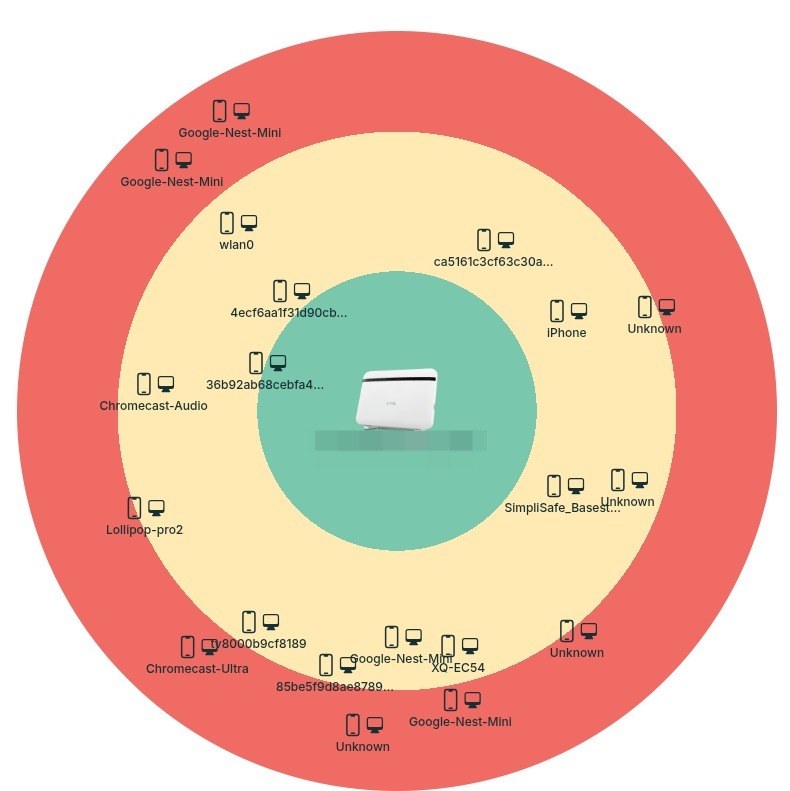
This level of granularity enables a new class of service analysis and diagnostics. Support teams are no longer limited to static snapshots of the network; they can observe behavior as it happens.
Additionally, continuous telemetry feeds can power automated diagnostics and intelligent alerting. Instead of waiting for a customer complaint, the system can detect anomalies proactively, opening the door for predictive support and improved customer experience.
Conclusion
Real-time bulk data collection represents a shift from reactive to proactive network management. By turning devices into continuous data producers, USP enables platforms to build a live, evolving picture of the network rather than relying on delayed or incomplete information.
Take control of your
network today
The world’s most widely used USP Controller and TR-069 ACS, with
enterprise-class features and no vendor lock-in.